|
Online observation of ion beam mixing using LAPSDT based ERDA at NSC – A very initial indication with Dr S V S Nageshwara Rao
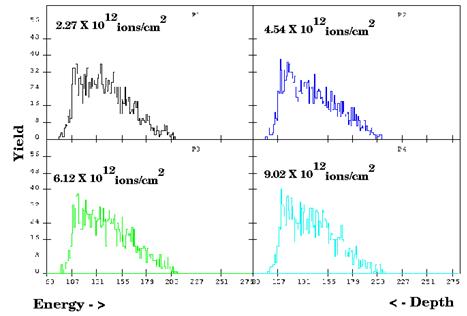
LAPSDT has been used to observe the online mixing in lattice matched InGaAs/InP superlattice (P520). LAPSDT based ERDA experiment has been performed using 150 MeV ions at a recoil angle of 55o in Goniometer Chamber. The projection of P band of the DE-E spectrum for different ion fluence is shown in figure1. A minimum fluence of 2.27 X 10¹² ions/cm2 was necessary to get sufficient statistics. Fig. 1a corresponds to this fluence and shows separate peaks corresponding to different layers. It should be noted that the sample contains P only in alternating layers which is reflected in fig. 1a. Fig. 1b, c & d correspond to higher fluences as shown in the respective figures. Higher fluences are chosen as multiples of the initial fluence so as to keep same statistics for all the spectra. Intermixing is clearly observed in this figure, the peaks in the P band are getting merged with increasing fluence. This is an indication that the online mixing experiments are possible with this facility. This type of online monitoring is necessary for achieving controlled modification. Moreover one can study all intermediate fluences rather than some selected fluences as done in off-line measurements. This is a major advantage of ion beam characterization technique when compared to other off-line characterization techniques. In this work it is found that the mixing effect starts appearing from a fluence of 4.54 X 10¹² ions/cm2 in this system if irradiated by 150 MeV Ag ions. In addition to this work, LAPSDT has been used in several cases to determine the initial stoichiometry and layer thickness of some of the samples. Channeling/Blocking - ERDA, Transverse heating/cooling of channeled ions, on-line radiation damage / modifications, sputtering and many such studies can be performed using this detector. Some of such experiments have already been performed by several users of NSC.
Fig.1: Online observation of ion beam mixing using ERDA – LAPSDT (projection of P band) (a) top left; (b) top right; (c) bottom left & (d) bottom right; Corresponding fluence is given in each figure
|