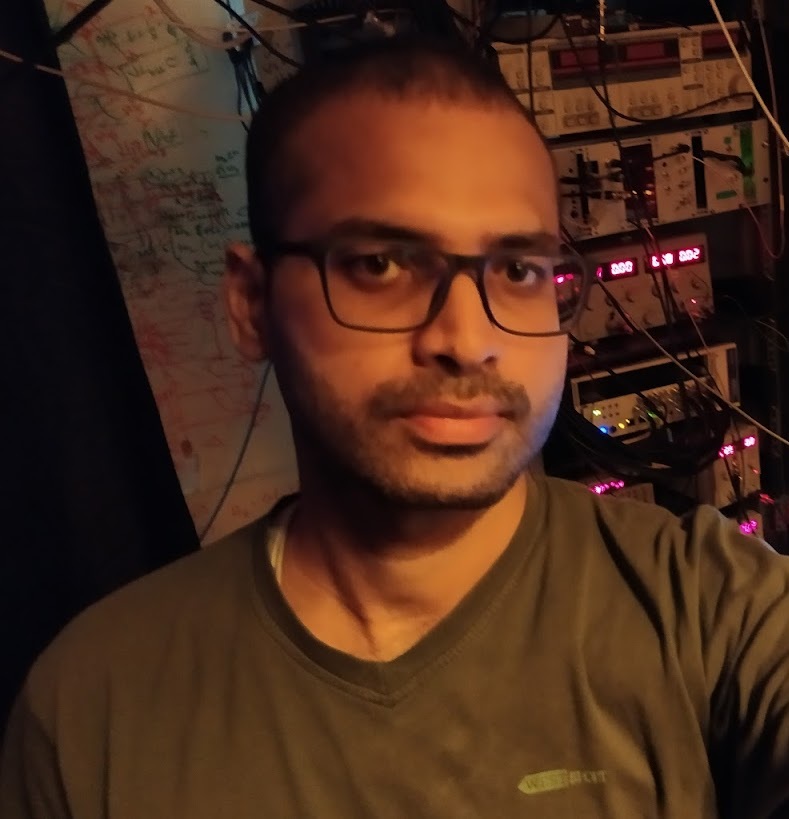
Dr. Tarun Dutta
Assistant Professor
School of Physics (Room No. P-031)
University of Hyderabad, India
Email: tarundutta@uohyd.ac.in
About Us
Our research focuses on developing a quantum computer using qudits based on trapped ions. These trapped ions form the core of our quantum processing units. We confine individual ions in space using electromagnetic fields, and then use lasers to handle everything from preparing their quantum states to reading out the results. This work brings together counterintuitive quantum physics, precision optical and mechanical engineering, and careful firmware control of many different components.
Trapped ions are one of the most promising platforms for building quantum computers. They offer extremely precise control over quantum states and have very long coherence times, meaning the quantum information stays intact for much longer compared to many other systems. This combination of control and stability makes trapped ions ideal for exploring both fundamental quantum science and practical quantum computing applications.
Key Areas of our research:
-
1. Quantum Computing & Machine Learning:
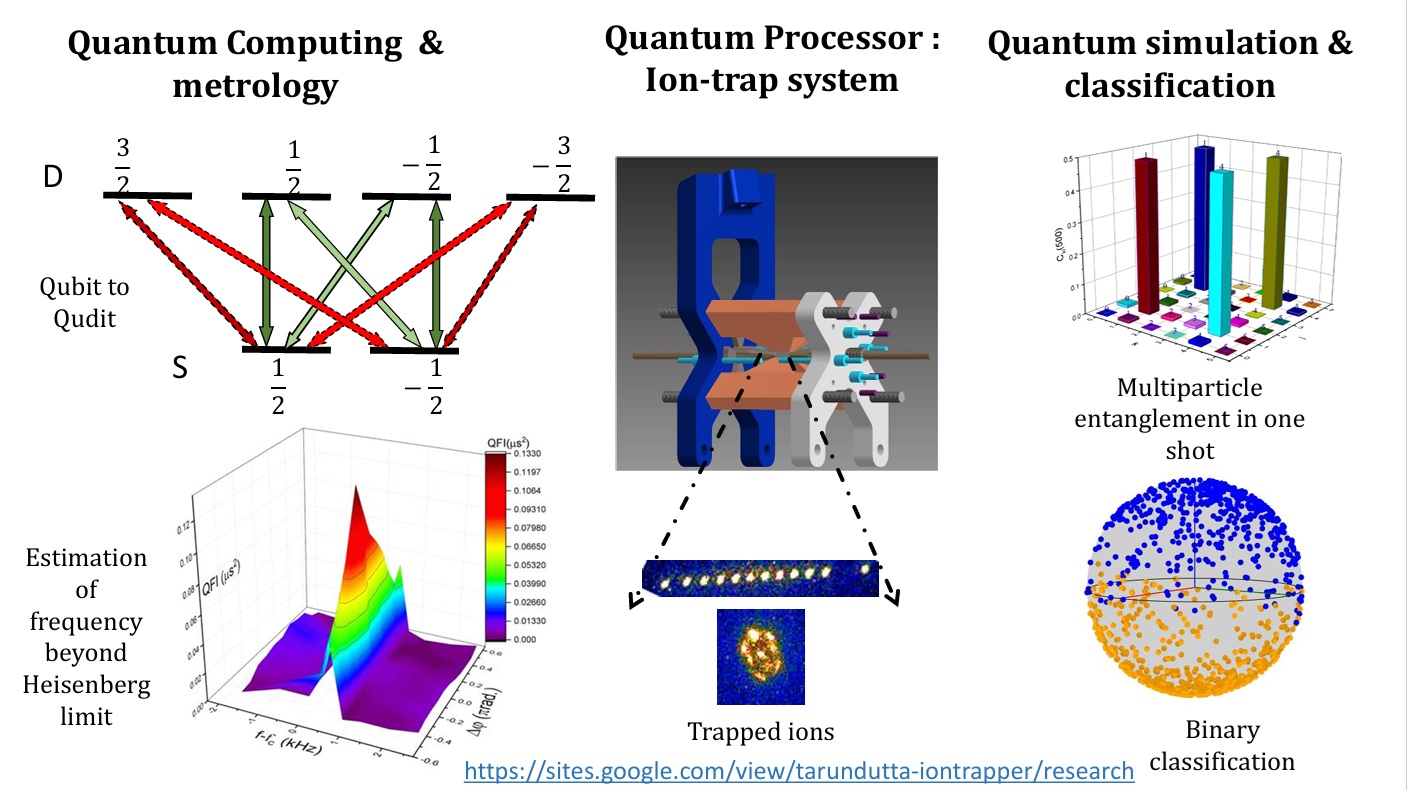
- A key focus of our work is developing quantum computers using qudits instead of qubits. While qubits store only two states (0 and 1), qudits can store more than two states (0, 1, 2, etc.), allowing us to encode more information per ion. This makes qudit-based quantum computers potentially more efficient than qubit-based ones. We are also developing methods to combine classical computers with quantum computers (known as hybrid quantum-classical systems) to make quantum devices easier to train and operate — especially during the current era where quantum devices are still noisy and imperfect (the NISQ era, or Noisy Intermediate-Scale Quantum era).
-
2. Quantum Metrology & Precision Measurement:
- Using a single trapped ion, we can measure physical properties with extremely high accuracy — even surpassing the Heisenberg limit, which is traditionally considered the ultimate precision bound in quantum measurements. These ultra-precise techniques are important for testing fundamental theories in physics and improving next-generation atomic clocks.
-
3. Quantum Simulation & Control
- We also study how to control and manipulate phonons — the quantized vibrations of ions in the trap. This allows us to simulate complex quantum systems, generate entanglement, and cool the ions to extremely low temperatures. These techniques are essential for improving the performance of both quantum computers and quantum sensors.
-
4. Spectroscopy & Laser Development
- Our research also involves developing specialized lasers and performing high-resolution spectroscopy — where we study how atoms absorb and emit light. This provides precise reference data for atomic experiments and improves our ability to manipulate trapped ions for both quantum computing and precision measurement applications.
Research positions and employment
- 2024 - : Assistant Professor, School of Physics, University of Hyderabad
- 2018 - 2024: Research Fellow, National University of Singapore (NUS)
Research Interests
- Our research focuses on developing Qudit-based Quantum computers using trapped ions system, a leading platform known for precise control and long coherence times.
- Quantum Computing: We are developing qudit-based quantum computers, where each trapped ion can store more than two states, making them more efficient than standard qubit systems. We also work on hybrid quantum-classical systems, combining classical computing power with quantum processors to improve trainability — especially important in today’s noisy intermediate-scale quantum (NISQ) era.
- Quantum Metrology & Precision Measurement: Beyond computing, we use single trapped ions for ultra-precise measurements, even surpassing the Heisenberg limit, to test fundamental physics.
- Specialized lasers and high-resolution spectroscopy: We develop specialized lasers and conduct high-resolution spectroscopy to improve ion control and provide accurate reference data for atomic experiments.
- Quantum Simulation & Control: We also study how to control phonons — vibrations in the ion trap — to simulate quantum systems, generate entanglement, and cool ions, all essential for advancing both quantum computing and quantum sensing.
Courses Taught
- PY162- Waves and Oscillations Lab
Notable Research Publications
- "Single-atom energy-conversion device with a quantum load," npj Quantum Information 6 (1), 37 (2020).
- "Single-qubit universal classifier implemented on an ion-trap quantum device," Physical Review A 106 (1), 012411 (2022).
- "Ramp dynamics of phonons in an ion trap: entanglement generation and cooling," Physical Review Letters 111 (17), 170406 (2013).
- "Nonequilibrium phonon dynamics in trapped-ion systems," Physical Review A — Atomic, Molecular, and Optical Physics 85 (6), 063401 (2012).
- "A single atom noise probe operating beyond the Heisenberg limit," npj Quantum Information 6 (1), 3 (2020).
For more information, please visit Google-scholar or Personal Home Page.